Whenever the bell of the lunar new year rings, more than one-fifth of the world’s population welcomes this grand festival filled with reunion, joy, and beautiful hopes—Chinese New Year, also known as the Spring Festival.
Do you know that behind this festival lies the world’s largest annual human migration? What stories lie behind every household pasting red couplets and giving red envelopes filled with blessings? What do the twelve Chinese zodiac animals mean, and what is so special about the 12-year cycle?
Whether you are hearing about this festival for the first time or want to deeply understand its cultural core, this article will unlock fun facts about Spring Festival and answer high-frequency questions!
1. Why do people celebrate Chinese New Year?
Answer:
The Spring Festival is the most important traditional festival for the Chinese nation. It originated from harvest sacrifices in ancient agricultural society. People celebrate Chinese New Year mainly to bid farewell to the old and welcome the new, pray for blessings and good fortune, ask for peace, health, happiness, and good luck in the new year, and pass on traditional Chinese culture.
2. When is Chinese New Year? Why does its Gregorian date change every year?
Answer: Chinese New Year 2027 falls on February 6, which is the first day of the first lunar month.
The Gregorian date of Spring Festival fluctuates between January 21 and February 20. This is because the traditional Chinese lunar calendar is a lunisolar calendar, different from the pure Gregorian calculation logic, and it refers to both the moon and sun cycles.
3. What is the difference between Lunar New Year and Chinese New Year?
Answer:
In mainland China, the two refer to the same festival, just with different names. Countries such as South Korea and Vietnam that also celebrate the festival prefer the neutral name “Lunar New Year.”
4. How can foreign tourists experience the Chinese New Year atmosphere?
Answer:
They can go to local Chinatowns to join festive activities, experience the New Year’s Eve dinner, distribute red envelopes, paste Spring Festival couplets, and watch dragon and lion dances. They can also plan a trip in advance and visit major cities such as Beijing, Shanghai, and Xi’an to experience the authentic Spring Festival atmosphere in person.
5. What are the most important traditional activities of Chinese New Year?
Answer:
Pasting Spring Festival couplets, setting off fireworks and firecrackers, giving red envelopes, eating the New Year’s Eve dinner, staying up late on New Year’s Eve, dragon and lion dances, paying New Year calls (visiting relatives and friends), watching the Spring Festival Gala, and more.
6. What foods are essential for Chinese New Year?
Answer:
In the north, people eat dumplings, symbolizing bringing in wealth and blessings; in the south, people eat tangyuan, symbolizing family reunion. Fish represents surplus year after year, rice cake implies rising higher step by step, roast duck symbolizes good fortune at the head, and eight-treasure rice symbolizes sweetness and happiness. All are indispensable dishes on the table.
7. How can you determine your Chinese zodiac sign based on your birth year?
Answer: For example, 1979 was the Year of the Goat. The zodiac cycles every 12 years, so 1991 (12 years after 1979), 2003 (24 years after 1979), 2015, and 2027 are all Goat years. The order of the twelve zodiac animals is: Rat, Ox, Tiger, Rabbit, Dragon, Snake, Horse, Goat, Monkey, Rooster, Dog, Pig. 1979 was the Year of the Goat; the following years 1980, 1981, and 1982 were the Monkey, Rooster, and Dog years respectively, and so on.
8. Why is it called “Chinese New Year”? Do other countries also celebrate this festival?
Answer:
Because the festival originated in China and celebrates the beginning of the new year according to the traditional Chinese lunar calendar. Many countries, including Vietnam, South Korea, Singapore, Indonesia, and Mongolia, also celebrate it, so it is often called “Lunar New Year.”
9. How long does Chinese New Year last?
Answer:
The Spring Festival is one of the longest festivals in the world. Traditional folk celebrations run from Little New Year (the 23rd day of the 12th lunar month) to the Lantern Festival on the 15th day of the first lunar month, totaling 23 days. The national statutory holiday was originally 7 days and has been extended to 8 days since 2025.
10. What is the relationship between the Lantern Festival and the Spring Festival?
Answer:
The Lantern Festival marks the official end of Spring Festival celebrations. People view decorative lanterns, solve lantern riddles, and eat tangyuan, symbolizing a perfect conclusion.
11. Why is Chinese New Year also called “Chunjie (Spring Festival)”?
Answer: The name “Spring Festival” was created in 1912, when China began to use the Gregorian calendar. To distinguish it from the Gregorian New Year’s Day, the traditional lunar new year was named “Spring Festival.” “Spring” represents the revival of all things and the beginning of a new year.
12. What are common gifts for Lunar New Year?
Answer:
Red envelopes (containing cash); fruit gift boxes; candy and pastries; tea, fine liquor, milk, health supplements, and more.
13. What zodiac sign is 2027? What is the meaning of the twelve-year zodiac cycle?
Answer: 2027 is the Year of the Goat. The 12 zodiac animals correspond to different personality traits and symbols of destiny, completing a cycle every 12 years, somewhat similar to how Western astrology divides signs by month. Order: Rat, Ox, Tiger, Rabbit, Dragon, Snake, Horse, Goat, Monkey, Rooster, Dog, Pig.
14. Why give red envelopes? How much money is usually put inside?
Answer:
Red envelopes symbolize warding off evil and conveying blessings. Amounts preferably use even numbers, as even numbers in Chinese culture represent auspicious pairs; usually 100–500 RMB; overseas Chinese use equivalent local currency.
15. Why is red everywhere during Spring Festival?
Answer: It comes from the ancient legend of the Nian monster: red color and loud noises can drive away the monster “Nian.” In Chinese culture, red represents good luck and joy and can also ward off misfortune.
16. What do dragon and lion dances represent, and what is their meaning?
Answer:
Performers wear dragon and lion props and perform dances, symbolizing driving away evil spirits and welcoming good luck. Such performances are often held at large festivals and shop openings.
17. What are some folk taboos during Spring Festival?
Answer:
Avoid saying unlucky words; do not sweep the floor on the first day of the New Year to avoid sweeping away good fortune; breaking objects is considered ominous; try to avoid arguments and conflicts, etc.
18. What is the meaning of setting off fireworks and firecrackers during Spring Festival?
Answer:
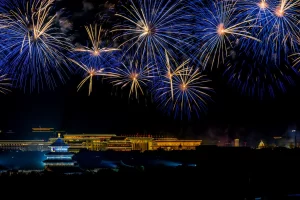
Traditionally, it was used to scare away the Nian monster. Today it is more used to enhance the festive atmosphere; however, many cities in China ban fireworks and firecrackers and only allow them in designated areas.
19. How do you say “Happy New Year” in Chinese?
Answer: 新年快乐, pinyin: Xīnnián kuàilè.
20. What is “Chunyun”?
Answer:
It refers to the large-scale population migration during Spring Festival. During Chinese New Year, hundreds of millions of people embark on the journey home to reunite with their families. It is the world’s largest annual human migration.
21. Is Spring Festival similar to Western Christmas?
Answer:
Both center on family reunion. However, Spring Festival focuses more on ancestor worship, praying for blessings, and folk rituals, and is not a religious holiday.
22. Why do people do a big cleaning before the New Year?
Answer: The pre-New Year big cleaning symbolizes bidding farewell to the old and welcoming the new, sweeping away bad luck, and welcoming the blessings of the new year.
23. What is “Chunwan”?
Answer:
The CCTV Spring Festival Gala broadcast on New Year’s Eve. It has extremely high viewership and is the most-watched variety show in the world, with 600–800 million viewers. The program includes songs, dances, skits, crosstalk, and more.
24. Which countries designate Spring Festival as a statutory holiday?
Answer: China, Singapore, Malaysia, Indonesia, the Philippines, South Korea, Vietnam, and others.
25. Why are children especially looking forward to Spring Festival?
Answer:
They can receive red envelopes, wear new clothes, set off fireworks in some areas, eat candy and snacks, and do not have to do homework.
From wonderful ancient legends to warm family customs, from Eastern life wisdom to simple folk beliefs, every detail of Spring Festival embodies profound cultural heritage and thousand-year spiritual wealth. We hope this Q&A can become your guide to understanding traditional Chinese culture, so that no matter where you are, you can feel this warmth and joy that spans thousands of years.
Wishing you and your family a Happy New Year, may all your wishes come true, full of joy, and may you prosper!
(Chinese pronunciation: Xīnnián kuàilè, wànshì rúyì, xǐqì yángyáng, gōngxǐ fācái!)