Table of Contents
ToggleChinese New Year: The Most Important Festival in the East
Chinese New Year, also called the Spring Festival, is the grandest traditional festival in China and across East and Southeast Asia. It carries thousands of years of cultural heritage and humanistic sentiment. Whenever the lunar new year arrives, households hang lanterns and decorations, paste Spring Festival couplets, set off firecrackers, and sit together for the New Year’s Eve dinner to bid farewell to the old and welcome the new.
This article will take you into Chinese New Year, unlocking its dates, ancient customs, signature foods, and zodiac culture, so you can feel the unique romantic heritage and life wisdom of this Eastern festival.
The Origin of Chinese New Year (Legend)
The Spring Festival traces back to ancient rituals of sacrifice at the beginning of the year. Legend says that in ancient times there was a monster called “Nian,” which came out to harass people at the end of winter and beginning of spring, when the old and new years alternated. Later, people discovered that the Nian monster feared the color red, firelight, and loud noises. Thus, customs gradually formed: pasting red couplets, setting off firecrackers, and beating gongs and drums. Since then, the Spring Festival has become the most important traditional festival of the Chinese nation.
Dates and Celebration Period in 2027
Chinese New Year (Spring Festival) 2027 falls on February 6, the first day of the first lunar month.
Strictly speaking, the Spring Festival is not just one day. The entire celebration period lasts 15 days, from the first day of the first lunar month to the Lantern Festival on the fifteenth day, which is also an important traditional Chinese festival.
In folk custom, celebrations begin with Little New Year on the 23rd day of the 12th lunar month and continue until the Lantern Festival on the fifteenth day of the first lunar month—about 23 days in total. Among these, New Year’s Eve (the last day of the 12th lunar month) and the first day of the first lunar month are the core of the festival. For Chinese people, no matter where they are, they try to return home for the new year and reunite with family.
Key dates for Spring Festival 2027 are as follows:
| Gregorian Date | Lunar Date | Title | Customs and Celebratio |
| 30.01.27 | 23.12.26 | Little New Year | Worship the Kitchen God, bathe and get a haircut, do a thorough spring cleaning |
| 05.02.27 | 29.12.26 | New Year’s Eve | Tomb-sweeping, enjoy the New Year’s Eve reunion dinner, paste Spring Festival couplets, stay up late on New Year’s Eve, give lucky money/red envelopes, set off firecrackers |
| 06.02.27 | 01.01.27 | First Day of the Lunar New Year | Opening firecrackers, pay New Year calls, exchange gifts, dragon and lion dances |
| 20.02.27 | 15.01.27 | Lantern Festival | View decorative lanterns, solve lantern riddles, perform dragon lantern dances, perform lion dances, eat tangyuan (sweet glutinous rice balls) |
What Zodiac Animal Is 2027
2027 is the Year of the Goat in the Chinese lunar calendar.
The Chinese zodiac, also called “shuxiang,” consists of twelve animals in a twelve-year cycle. The order is: Rat, Ox, Tiger, Rabbit, Dragon, Snake, Horse, Goat, Monkey, Rooster, Dog, Pig.
For example: 2025 is the Year of the Snake; after the Snake comes the Horse, and after that the Goat. So 2026 is the Year of the Horse, 2027 is the Year of the Goat, and the cycle repeats.
A person’s zodiac sign is determined by the animal of the year in which they were born. Folk belief holds that the zodiac can influence a person’s character and destiny. For example, people born under the Rat are considered clever and quick-witted, while those born under the Dragon are seen as confident and extraordinary. Interestingly, people often chat about personality based on zodiac traits and fortune-telling theories, and also use the zodiac as a reference for matchmaking, checking whether two signs are compatible.
New Year Traditions and Celebrations
Chinese New Year is the traditional festival with the longest history and the grandest scale in the Chinese nation. The whole set of festive rituals integrates sacrificial rites, family ethics, folk beliefs, and festive entertainment. The main Spring Festival customs are as follows:
- Sending Off the Kitchen God
Folk legend says that on Little New Year (the 24th day of the 12th lunar month), the Kitchen God goes to heaven to report to the Jade Emperor on the good and bad deeds of the household over the past year. Every family prepares candy and snacks as offerings, hoping to stick the Kitchen God’s mouth shut or make him say good things, praying that he will “say good things in heaven and bring peace back to earth.”
- Sweeping the Dust (Cleaning)
The whole family thoroughly cleans the house, scrubs utensils, washes bedding, and sweeps the courtyard. This is not only about welcoming the new year cleanly; it also carries a deeper meaning: removing the old and laying out the new, sweeping away past misfortune and bad luck, and welcoming the new year’s blessings.
- Buying New Year Goods and Decorating the Home
People rush to markets to buy ingredients, new clothes, shoes and socks, fireworks, and firecrackers. They paste Spring Festival couplets and door god pictures on the home, paste the character “Fu” upside down (meaning fortune has arrived at the door), and add delicate paper cuttings and New Year paintings, so the festive atmosphere instantly overflows.
- New Year’s Eve Dinner (Reunion Dinner)
This is the most important, grandest, and warmest part of the Spring Festival. No matter how far away they are, wanderers return home. The whole family sits around one table, sharing dishes cooked with their own hands, chatting about the year’s gains and losses, and watching the CCTV Spring Festival Gala. This meal is not only about tasting delicious food, but also about the warmth of family affection and the hope for a prosperous and peaceful year ahead.
- Giving Lucky Money
After the meal, elders prepare red envelopes containing money for the younger generation. Legend says lucky money can suppress evil spirits and protect children through the new year safely. Red envelopes carry elders’ deep love and blessings.
- Staying Up on New Year’s Eve
On New Year’s Eve, lights are kept bright, and the whole family stays awake, sitting together chatting, eating snacks, playing, and watching the Spring Festival Gala, quietly waiting for the New Year bell to ring and exchanging blessings. Staying up on New Year’s Eve symbolizes cherishing time and praying for elders’ longevity and health, children’s safety, and adults’ smooth success in all matters.
- Setting Off Firecrackers and Paying New Year Calls
On the morning of the first day of the first lunar month, the first thing is to set off firecrackers to drive away bad luck and welcome auspiciousness. After that, people put on new clothes, visit relatives and friends, and say “Happy New Year” and “May you prosper.” This is New Year greeting. Paying New Year calls is an important social way to maintain relationships and pass on good wishes.
- Worshipping Gods and Ancestors
This is a solemn traditional folk ritual. During the festival, elders lead the whole family, dressed formally, to the ancestral hall, where they offer sacrifices, burn incense, and bow in worship. They remember the protection of ancestors and gods and entrust their hopes for favorable weather and a prosperous household.
- Watching Folk Performances
During the festival, various folk performances take turns on the streets, creating a lively scene. Dragon and lion dances are the most representative programs, symbolizing the driving away of evil and the welcoming of blessings. There are also temple fairs, stilt walking, Yangge, shadow puppetry, acrobatics, and more, pushing the festive atmosphere to a climax.
- Viewing Lanterns and Solving Lantern Riddles
The Lantern Festival is the first traditional festival after the Spring Festival. Viewing lanterns and solving riddles is its most moving custom. At night, streets, courtyards, and parks are hung with all kinds of exquisite lanterns, like stars scattered across the sky. Riddles are often written on the lanterns, adding elegant charm.
- Eating Yuanxiao
The warmest ritual of the Lantern Festival is eating a bowl of hot yuanxiao. The glutinous rice outer skin wraps sweet fillings such as sesame, red bean paste, and peanut; they are round, soft, and chewy. The round shape again echoes the theme of reunion, symbolizing family harmony and peace, and brings the whole Spring Festival to a complete conclusion.
Chinese New Year Food
There is an old saying in China: “Food is the first necessity of the people.” Therefore, during Chinese New Year, the most important festival, food naturally becomes the supreme star for passing on culture and emotion. Below are the five essential foods of Chinese New Year.
Fish: A Blessing of Surplus Year After Year
Fish sounds like “surplus” in Chinese, meaning surplus, abundance, and savings. It symbolizes “surplus year after year, abundance and peace.” This clever homophone culture makes fish an indispensable soul dish on the Chinese New Year table.
Rice Cake: A Wish for Rising Higher Step by Step
Rice cake sounds like “year high” in Chinese, meaning rising higher year after year. It symbolizes “rising step by step, a happy life.” Rice cake is soft, chewy, and springy, with a clear sweet taste, rich rice aroma, and gentle sweetness.
Roast Duck: A Hope for a Flourishing Career
Roast duck is bright red and shiny, shaped like the fruit of harvest, symbolizing “good fortune at the head, a bright future.” The skin is crisp, the meat tender and rich, with a fruity wood aroma and a mellow flavor blending savory and sweet.
Dumplings: A Symbol of Bringing in Wealth and Treasure
Dumplings are shaped like ingots and contain a hundred flavors within, symbolizing “wealth and reunion.” They can be boiled, steamed, pan-fried, or seared. A thin wrapper holds fresh fragrance; with one bite, the juices overflow, and the aroma of meat and vegetables blends together.
Tangyuan: A Hope for Reunion and Happiness
Tangyuan is round like jade beads, wrapping sweetness, symbolizing “family reunion and a happy life.” The soft, chewy outer skin wraps a sweet flowing center; the texture is dense and delicate, giving off a gentle rice aroma and sugar fragrance.
Chinese New Year Superstitions and Taboos
Behind Chinese New Year lies countless ancient wisdom for seeking good luck and avoiding bad luck. From the New Year’s Eve dinner to opening the door to welcome spring, every action may be linked to the fortune of the whole year. Therefore, during the New Year period, following traditional customs and taboos can help you seek good luck and avoid bad luck, bringing full blessings and good fortune to yourself and your family.
- Avoid saying unlucky words
New Year is an auspicious time, and people greet each other with auspicious words. Words such as “death,” “illness,” and “poverty” may bring bad luck and should be replaced with auspicious expressions.
- Avoid sweeping the floor on the first day of the New Year
On the first day of the New Year, the good fortune and wealth accumulated at home should not be swept away, lest “wealth” be swept out. Usually, people wait until after the fifth day, when the God of Wealth is welcomed, before cleaning, meaning to keep wealth and blessings from flowing out.
- Avoid damaging objects
Breaking objects symbolizes “broken luck” and may bring financial loss or bad luck. If something is broken accidentally, one should immediately say “peace every year (sui sui ping an)” to dissolve it, using the homophone to turn danger into safety.
- Avoid quarrels or scolding children
New Year values harmony. Quarrels destroy family harmony and may bring “a whole year of trouble.” Even if children make mistakes, they should be guided patiently to keep a peaceful atmosphere at home.
- Avoid lending money or collecting debts
Lending money out during the New Year symbolizes “loss of wealth,” while collecting debts may cause conflict and destroy harmony. Tradition holds that New Year should be a time to gather wealth and avoid financial disputes. Therefore, lending and debt collection should be completed before the New Year if possible.
- Avoid haircuts during the first lunar month
The Chinese character “fa” is related to “facai” (making a fortune), and cutting hair may cut off “wealth luck.” This is especially taboo during the first lunar month; people wait until “Dragon Heads-raising Day” on the second day of the second lunar month to get haircuts, symbolizing renewal and the start of good luck.
- Avoid killing living creatures
The first day of the New Year is a time for living beings to rest and for heaven and earth to be benevolent. Killing and seeing blood may clash with festive energy. Meat ingredients should be prepared in advance, avoiding slaughter on the day itself, so as to accumulate virtue.
Popular New Year Greetings
During the Spring Festival, people exchange blessings to express gratitude and expectations. Beautiful words are said to attract good luck, bid farewell to the worries of the old year, and welcome happiness and peace.
- 新年快乐 (Xin nian kuai le) – Happy New Year!
- 恭喜发财 (Gong xi fa cai) – Wishing you wealth!
- 羊年大吉 (Yang nian da ji) – In the Year of the Goat! Great happiness!
- 万事如意 (Wan shi ru yi) – May all your wishes come true!
- 身体健康 (Shen ti jian kang) – Good health!
- 阖家欢乐 (He jia huan le) – Family happiness and well-being!
- 事业有成 (Shi ye you cheng) – Success in your career!
- 步步高升 (Bu bu gao sheng) – Step-by-step career advancement!
- 财源广进 (Cai yuan guang jin) – Financial prosperity!
Lunar New Year Celebrations in Other Countries and Regions
Lunar New Year originated in mainland China. With population migration and cultural exchange, it spread widely throughout the Chinese cultural sphere and became an important festival in many Asian Chinese communities. This traditional festival has gone global, carrying the homesickness of overseas Chinese and becoming a bridge for exchange and mutual learning among civilizations.
1. Chinese Regions: Taiwan, Hong Kong, and Macao — Deep Chinese Traditions
As an inseparable part of China, Hong Kong, Macao, and Taiwan all celebrate Lunar New Year grandly, and all are public holidays there.
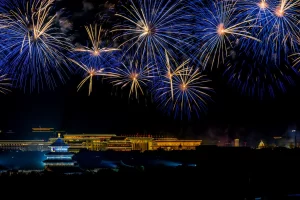
Hong Kong: The holiday lasts three days (from the first to the third day of the first lunar month). Signature activities include the New Year’s Eve parade, Victoria Harbour fireworks on the second day, and horse racing at Sha Tin; traditional charm blends with modern city views.
Macao: Also a three-day holiday. The festive atmosphere is strong; hotels and casinos are elaborately decorated and arrange dragon and lion dances. The unique Portuguese-influenced local style makes New Year here especially distinctive.
Taiwan: The holiday is no less than six days (usually from New Year’s Eve to the fifth day of the first lunar month), and traditional customs are well preserved. People go to temples to grab the first incense, give zodiac red envelopes, and the grand lantern festival is the core of local New Year culture.
2. Southeast Asia: Tradition Meets Local Character
In Singapore, Malaysia, Indonesia, the Philippines, and Vietnam, Lunar New Year is a public holiday. Customs such as dragon and lion dances, red envelopes, and reunion dinners are well preserved and blended with local features. For example, Malaysia’s yusheng (lo hei) tosses ingredients high together while everyone shouts blessings, symbolizing rising higher step by step. These customs were brought by early Chinese immigrants and gradually developed into a multicultural celebration.
3. East Asia: Shared Roots, Distinct Flavors
Korea’s Spring Festival is called 설날 (Seollal). It values ancestor worship and family rites; younger people bow to elders, and people eat rice cake soup, symbolizing adding a year and welcoming the new.
Japan’s New Year is also called “Shogatsu” (正月). People eat buckwheat noodles, place kadomatsu (door pines) and kagami mochi (mirror rice cakes) at home to welcome the New Year god, exchange New Year’s cards, give children otoshidama (lucky money), and go to shrines for hatsumode (the first shrine visit). It is Japan’s most important traditional festival.
Both originated from ancient Chinese culture and gradually evolved into folk styles unique to their own countries.
4. Europe, the Americas, and Central Asia: From Chinatowns to the Public Eye
In international cities such as New York, London, Sydney, and Toronto, Lunar New Year has long moved beyond Chinese communities and become a widely recognized multicultural event. Trafalgar Square in London lights up zodiac decorations; the Empire State Building in New York shines in Chinese red; the Sydney Opera House is bathed in Chinese red and hosts a New Year lantern festival; Toronto City Hall hosts a New Year market and dragon dance performances; Paris City Hall hangs Spring Festival couplets… These activities are the world’s recognition of Chinese culture and witness the continuous expansion of China’s cultural influence.
Fun Facts and FAQs About Chinese New Year
1. When is Chinese New Year? Why does the date change every year?
Chinese New Year 2027 is February 6. The Gregorian date fluctuates between January 21 and February 20. The reason is that the lunar calendar is calculated by moon phases, with a year of about 354 days; the Gregorian calendar follows the tropical solar year, with a year of about 365 days. To make up the difference, the lunar calendar adds a leap month about every three years, so the date of Chinese New Year differs each year, always falling at the turn between winter and spring.
2. Why celebrate the Spring Festival?
The Spring Festival represents bidding farewell to the old and welcoming the new; it is a time for family reunion. It carries respect for ancestors, values the importance of family, and expresses people’s hopes for health, peace, and abundance in the new year.
3. What is the difference between Lunar New Year and Chinese New Year?
In China, the two are basically equivalent. “Lunar New Year” emphasizes the calendar attribute, while “Chinese New Year” emphasizes cultural belonging. However, countries such as Korea and Vietnam also celebrate this festival, and they prefer the neutral term “Lunar New Year.”
4. What is the most important food of the Spring Festival?
In the north, dumplings are a must, symbolizing bringing in wealth and the transition between old and new; in the south, tangyuan is the main food, symbolizing reunion. In addition, fish (surplus year after year), rice cake (rising higher step by step), and eight-treasure rice (sweetness and abundance) are all essential foods.
5. How can foreigners experience the Spring Festival atmosphere?
They can go to local Chinatowns, prepare a New Year’s Eve dinner, exchange red envelopes, paste Spring Festival couplets and paper cuttings, and watch dragon and lion dances. Or they can come to China in person and experience authentic New Year customs.
6. What are the most important traditional customs of the Spring Festival?
- New Year’s Eve reunion dinner
- Setting off firecrackers to drive away evil
- Giving red envelopes
- Hanging red auspicious decorations at home
- Visiting relatives and friends to pay New Year calls
In addition, dragon and lion dances, visiting temple fairs, and worshipping ancestors and praying for blessings are all core New Year customs.
7. What zodiac is 2026? What is the meaning of the twelve-year cycle?
2026 is the Year of the Fire Horse. The twelve-year zodiac cycle is not only a way of counting years, but also a unique cultural symbol. People believe that the zodiac gives those born in that year corresponding personality traits and influences character and destiny.