The twelve Chinese zodiac signs are a highly significant symbol in traditional Chinese culture. Behind each zodiac animal lies a unique legend and origin story. These stories are widely circulated among the people and have become an inseparable part of Chinese culture. So where exactly did the twelve zodiac signs come from? What stories and cultural connotations do these animals carry?
What Is the Chinese Zodiac (Birth-Year Animal Signs)?
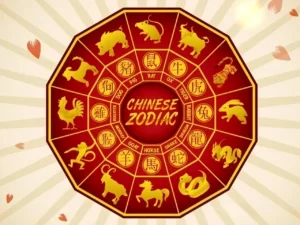
The twelve zodiac signs, also called the twelve birth symbols, pair twelve animals with the twelve Earthly Branches to record years. They are deeply integrated into folk customs, beliefs, art, and daily life.
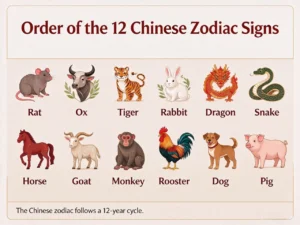
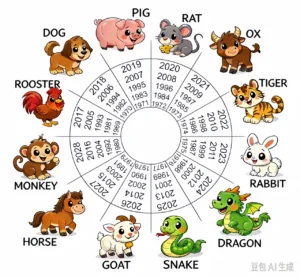
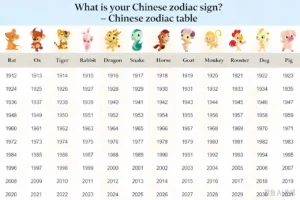
Every person has their own zodiac symbol from birth. The twelve animals in order are: Rat, Ox, Tiger, Rabbit, Dragon, Snake, Horse, Goat, Monkey, Rooster, Dog, Pig. Each corresponds to one year, completing a full cycle every twelve years. Folk custom uses the animal corresponding to one’s birth year as a reference for personality traits, yearly fortune, romantic compatibility, and career prospects.
After one cycle ends, the system starts over again, repeating endlessly. If two people are 12 years apart in age, they are one zodiac cycle apart; if 24 years apart, two cycles.
Zodiac Calculator: Find Your Own Zodiac Sign
Want to accurately find your guardian zodiac sign? You can use our free zodiac tool on this site. Enter your Gregorian birthday to look up your zodiac sign, five-element attribute, personality traits, lucky numbers, lucky colors, lucky flowers, and best-matched zodiac partner.
Chinese Zodiac Calculator – What Is My Chinese Zodiac Sign?
The Four Major Theories on the Origin of the Twelve Zodiac Signs
The twelve zodiac signs are a year-counting system deeply rooted in East Asian culture, growing up alongside generations of Chinese people. It did not emerge out of thin air overnight; it is the result of continuous blending and evolution of myths and legends, astronomical calendars, and ancient philosophy, embodying the ancients’ wisdom in observing nature and understanding time. Among these, the most widely spread and influential is the folk legend of the Jade Emperor holding an animal river-crossing race.
1. Mythological Legend Hypothesis (Most Widely Spread Among the People)
This is the most familiar version to the public and leans toward cultural storytelling.
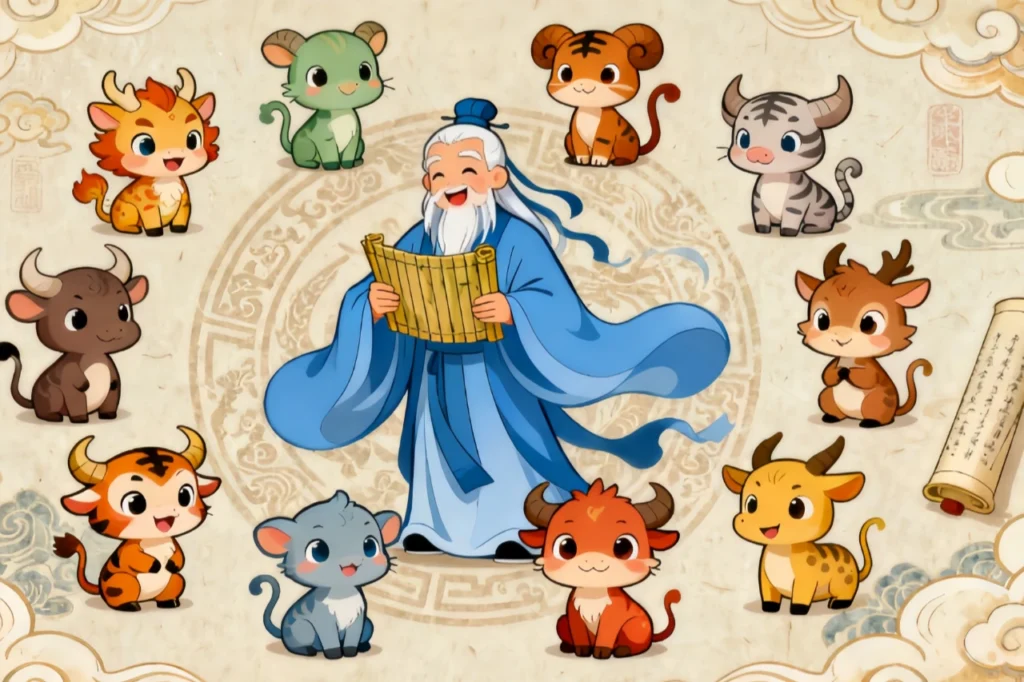
Legend says that to select animals to represent each year, the Jade Emperor held a river-crossing race. The order in which the animals reached the finish line formed today’s order of the twelve zodiac signs. The rat won first place through its cleverness, and the pig arrived last, ranking twelfth.
This story explains the zodiac order in a popular and vivid way while conveying moral ideas such as honesty, wisdom, diligence, and cooperation. It is an important vehicle for spreading zodiac culture among the people and reflects Chinese culture’s admiration for wisdom, diligence, and virtue.
Further reading: The Legend of the Twelve Zodiac Signs: The Mysterious Story Behind the Animal Order
2. Astronomical and Celestial Hypothesis (Highly Recognized in Academia)
This is currently the theory generally accepted in academic circles. Its core is that the twelve zodiac signs are deeply bound to the twelve Earthly Branches and celestial natural phenomena.
Ancient people observed the movement of celestial bodies over a long period and found that Jupiter’s orbital period around the sun is about twelve years. The ancients called Jupiter the “Year Star” (Suixing) and used it as an important basis for counting years. At the same time, the ancients divided a day and night into twelve shichen (double-hours), using the twelve Earthly Branches—Zi, Chou, Yin, Mao, Chen, Si, Wu, Wei, Shen, You, Xu, Hai—to mark time, forming a complete timekeeping system.
The characters of the Earthly Branches are themselves very abstract. To make them easier for ordinary people to understand and spread, the ancients gradually matched each Earthly Branch with a familiar animal, also combining the animals’ living habits. For example, the Zi hour (23:00–01:00) is exactly when rats are frequently active, corresponding to the Rat; the Mao hour (05:00–07:00) is dawn, when rabbits come out of their burrows to forage, corresponding to the Rabbit. Thus the complete twelve zodiac system was formed.
3. Agricultural Civilization and Animal Worship Hypothesis
This view holds that the twelve zodiac signs originated from China’s early agricultural society and animal worship traditions.
In agricultural society, animals were closely tied to human survival. Almost all the animals selected for the twelve zodiac signs were important roles in ancient life: oxen and horses were the core labor force for farming and transportation, directly related to grain production; goats, chickens, dogs, and pigs, as the “six domestic animals,” provided meat and textiles; wild animals such as tigers and snakes were inseparable from the hunting life and natural environment of early people; the dragon was an imagined totem combining features of multiple animals, symbolizing favorable weather and a bumper harvest, carrying the ancients’ beautiful wishes for a good harvest. Over time, this set of animal symbols kept accumulating and developed into the twelve zodiac signs.
4. Ancient Tribal Totem Worship Hypothesis
Totem worship and agricultural civilization are important cultural foundations for the birth of the twelve zodiac signs, fitting the living environment and spiritual beliefs of ancient humans, and spread very widely.
In ancient times, each tribe often chose a certain animal as its tribal totem, regarding it as the tribe’s guardian or the incarnation of ancestors. Oxen, tigers, snakes, dragons, and others were core totems of many tribes at the time. With tribal merging and cultural exchange, different totems from various regions gradually integrated, and twelve animals were selected and incorporated into a unified year-counting system, becoming a common cultural symbol transcending tribal boundaries.
What Is Benmingnian?
Benmingnian, also called the zodiac birth year or the year of offending Tai Sui, refers to the year in the lunar calendar whose zodiac sign matches one’s birth sign. The twelve zodiac signs cycle repeatedly, and a benmingnian comes every twelve years. It is an important time node in life. Your birth year is your first benmingnian; afterward, at ages 12, 24, 36, 48, 60, 72… you will encounter benmingnian again.
For example: if you were born under the Goat, then every Goat year is your benmingnian. 2027 is the Year of the Goat, so people born under the Goat will welcome their benmingnian in 2027; 12 and 24 years later, in the Goat years 2039 and 2051, they will encounter benmingnian again.
Many people assume that the year their own zodiac sign takes charge should be smooth in everything. But in traditional Chinese belief, benmingnian is often associated with “offending Tai Sui,” and it is believed that this year is prone to ups and downs and tests. But looking deeper, benmingnian is essentially China’s unique life-cycle marker system, reminding people to examine themselves, adjust their state, and start anew at specific nodes.
Further reading: Benmingnian (The Year of Offending Tai Sui): Meaning, Traditional Customs, and Things to Know
The Cultural Heritage of the Twelve Zodiac Signs
The twelve zodiac signs are a symbol system with extremely strong vitality in traditional Chinese culture. Using twelve animals such as the rat, ox, tiger, and rabbit as carriers, they closely link time, nature, and human destiny, forming a cultural expression that has continued for thousands of years.
Its origins can be traced back to the pre-Qin era (2000 BC–200 BC), blending the ancients’ reverence for nature, totem beliefs, and astronomical calendar wisdom. After thousands of years of accumulation, from sacrificial rituals to daily life, it has been engraved into the nation’s cultural genes. To this day, the twelve zodiac signs still deeply influence people’s understanding of years, personality, destiny, and life stages.
The Contemporary Value of the Twelve Zodiac Signs
In ancient times, besides counting years, the zodiac also served the functions of identity recognition and emotional connection. People used the zodiac to build consensus on age, generations, and interpersonal relationships, enhancing cultural cohesion.
In modern society, the twelve zodiac signs have been given new contemporary meaning, becoming a bridge connecting traditional culture and modern life, widely used in festive activities, artistic creation, and travel experiences.
Today, the twelve zodiac signs are even more a bond for cultural dissemination, deeply integrated into travel experiences. Through continuous reinterpretation, zodiac culture is passed down from generation to generation and keeps thriving. For example: in the 2027 Year of the Goat, tourists born under the Goat can travel to Yuexiu Park in Guangzhou (the Five Rams Statue), Yangtou Mountain in Shanxi, and other places, turning the journey into a ritual of experiencing culture and praying for good fortune.